Showing posts with label birds. Show all posts

Thursday, December 23, 2010

Who's at the feeder

We've had a our first few inches of snow this past week and the birds are flocking to the backyard feeders.  I like to hang suet for the woodpeckers and a mixed seed feeder which the songbirds prefer.  My "blind" is a curtained living room window that overlooks the back yard.  It's hard to sneak the squeaky screen up and down without scaring off the birds, but I have managed to get some photos.  Of course, the crazed barking Sheltie at my side doesn't help matters much.  Here's who we've seen so far:

The juncos were some of the first birds to arrive, hopping and pecking around the ground below the feeders.

They're peaceful and don't seem to mind the company of others like this male cardinal.

The tufted titmice are always present, side by side with plenty of chickadees.

  These cheeky little birds allow us to get pretty close before flying off.

By far my favorite visitor has been this red-breasted nuthatch.  There are plenty of white breasted nuthatches, but I haven't seen a red one in many years.  This bird comes every day and prefers suet to seed.  This bird's tiny size doesn't stop it from fighting off every other bird that comes to the feeders.


One of the largest birds is this hairy woodpecker.  Despite his size, this male is very easily frightened away by the slightest noise or intrusion.


.
He can only peck at the suet from outside the squirrel proof cage, so he'll fly to the ground to pick bits of suet that he's managed to break off.


Unlike the hairy woodpecker, the downy woodpeckers are small enough to fit inside the suet cage.


Some other ground visitors include blue jays,

mourning doves,


white-throated sparrows, and


female cardinals.


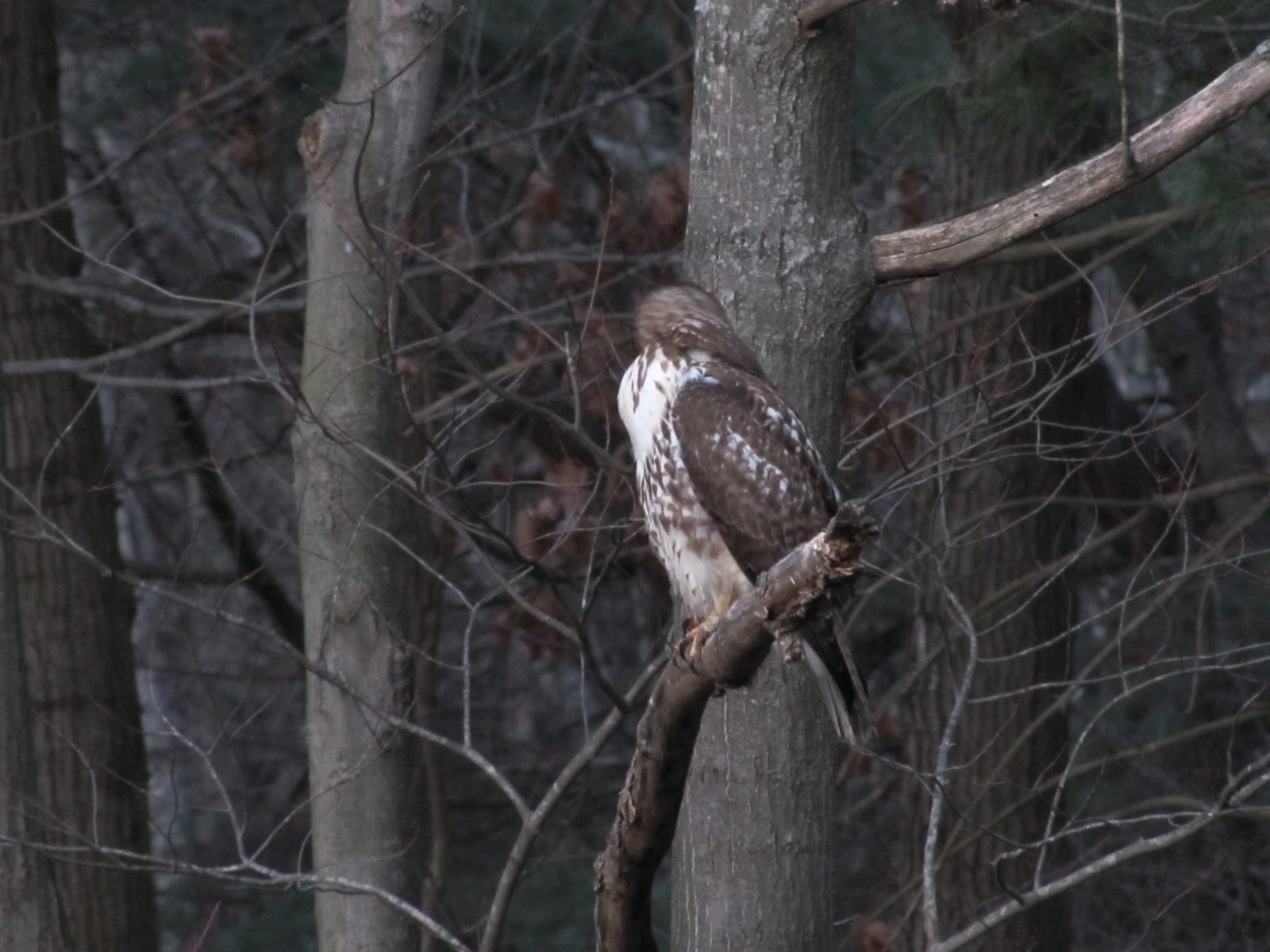
But no one can clear a feast like the red-tailed hawk that patrols the neighborhood feeders.  This hawk landed in a tree just behind our house and I was lucky enough to catch a couple of quick shots at dusk before it flew off.


Hang some feeders and enjoy the show!

Friday, March 27, 2009

Birds of Aruba


I'm a bird lover, so before leaving for Aruba I looked up what birds I might expect to see while on the island. Our grand total came to 19 species: frigate bird, bananaquit, grassquit, mocking bird, hummingbird, brown pelicans, terns, osprey, kestrel, Aruban parrots or Prikichi, doves, egrets, herons, gulls, ruddy turnstones and oystercatchers. But by far the most surprising and breath-taking sight was the Caracara(Caracara plancus). Also called the Mexican Eagle, it is a large black bird with white markings. It is actually a member of the falcon family. The first one I spotted was perched atop a tall cactus just outside of Arikok. I managed to snap a shot of it just before and after it flew off.

We had at least two more similar sightings in Arikok, but the best encounter happened on the night before we left Aruba. We were driving up to witness the sunset at the California Lighthouse on the westernmost tip of the island. As we passed an area with tall grass, I noticed a large brown bird hopping up and down. My husband was able to slow down enough for me to get these shots of a young Caracara. This bird's plummage was much lighter in color and browner than the adult Caracaras we had spotted in the national park. Perhaps it was trying to kill or flush out prey. A lizard, maybe?


Their size is amazing. With a body length of up to 23 inches and a 4-foot wingspan, the Caracara is an impressive bird. These birds have a thick heavy bill for feeding on carrion, small mammals, amphibians, reptiles, and a host of other foods. Their range extends from the southwestern United States southward to Central and South America. For more information about Caracaras including a recording of their call, check out Cornell Lab of Ornithology at http://www.birds.cornell.edu/AllAboutBirds.